Concept white paper · November 2026
A managed civic work-order network
Written by Michael Ruiz. The working iPhone prototype's screens and two live demos sit inside the chapters where they belong.
01Abstract
Residents are asked to report potholes, dumped furniture, graffiti and broken lights, but most reporting tools end at "submitted."
The report enters a queue the resident cannot see, and the resident rarely learns who has it or how it ended. CivicFix is a concept for closing that loop. Every report is verified and routed by an accountable program operator, each route is explained to the reporter, and a narrow set of low-risk tasks can be published as partner-funded work that verified workers complete with photo proof.
CivicFix is not an open gig marketplace. Residents never post cash bounties, and unqualified people are never paid to touch regulated infrastructure. This paper describes the problem, the model, the rules that keep it safe, what the working iPhone prototype demonstrates, a proposed pilot and the questions a first partner would need to answer.
02The problem
A resident who reports a public problem wants three things: to do it quickly, to know it reached the right people, and to see what happened next. Current civic reporting usually delivers only the first. Once submitted, a report is handed to an agency map the resident does not understand. Status, if shown at all, is a single word. When a case is closed, the reporter often cannot tell whether it was fixed, merged with another report, sent elsewhere or dismissed.
That silence has a cost. People who never see results stop reporting, and the city loses its cheapest source of street-level information. Meanwhile, some of the most common problems, like dumped furniture, litter and graffiti, are low-risk and inspectable, yet still wait in the same queue as regulated repairs.
03Why current tools fall short
Reporting-only tools
Collect good data but stop at intake. They rarely show the route a report took, who owns it now, or the evidence that it was resolved.
Open task marketplaces
Move faster but remove accountability. Nobody is responsible for safety, scope, insurance or quality, and untrained people get sent into work that belongs to qualified crews.
CivicFix
Sits between the two: the visibility of a modern app with the accountability of a managed program.
04The CivicFix model
CivicFix is a managed work-order network. The differentiating mechanism is the accountable handoff: every report is verified and routed by an operator, every paid task is funded and scoped by a partner, and the original reporter can always see the route and the result. Four participants share one system.
- Resident
- Notices a public problem and reports it with a photo, location and the impact they can see. Follows the case to its outcome.
- Program operator
- A city team, nonprofit or business district that verifies reports, removes duplicates, confirms jurisdiction, chooses the route, funds paid work and reviews results.
- Verified worker
- An approved person who claims partner-funded, low-risk work orders, follows the scope and safety checklist, and submits before-and-after proof.
- Volunteer
- Joins partner-organized cleanup events. Their time is recorded separately from paid work.
05The work-order lifecycle
Every case moves through the same plain-language stages, so residents, workers and operators read status the same way. Scroll through one case in the prototype.
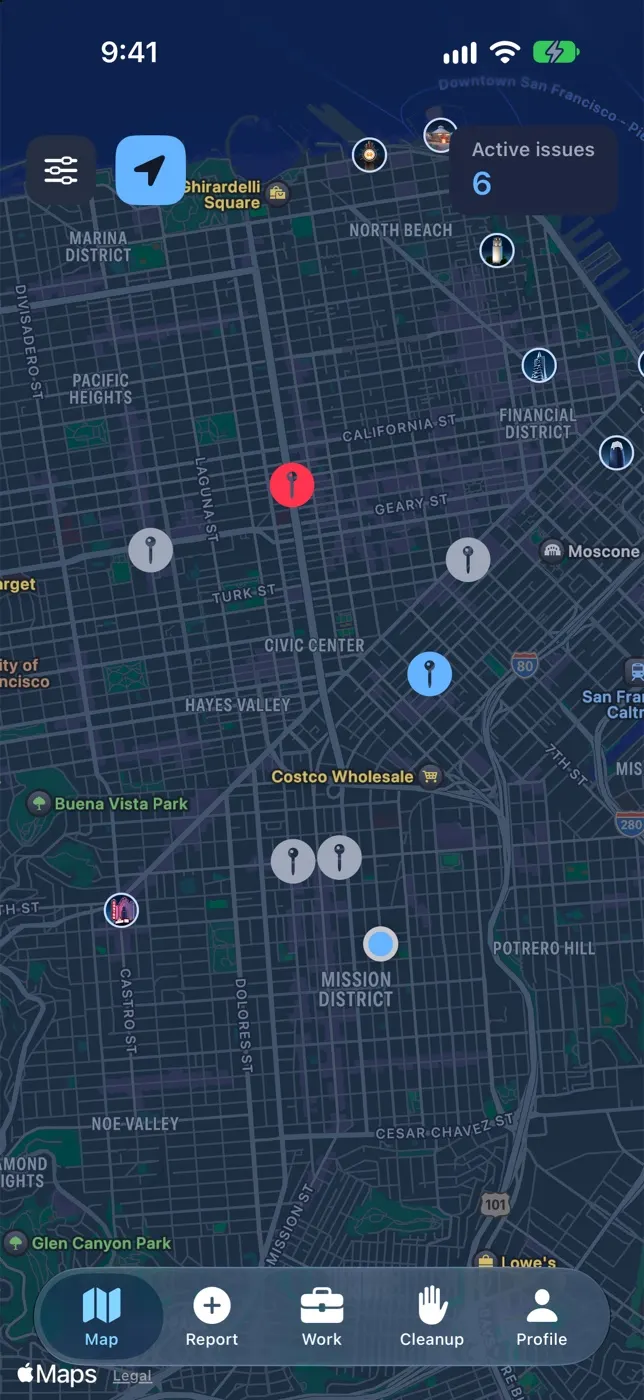
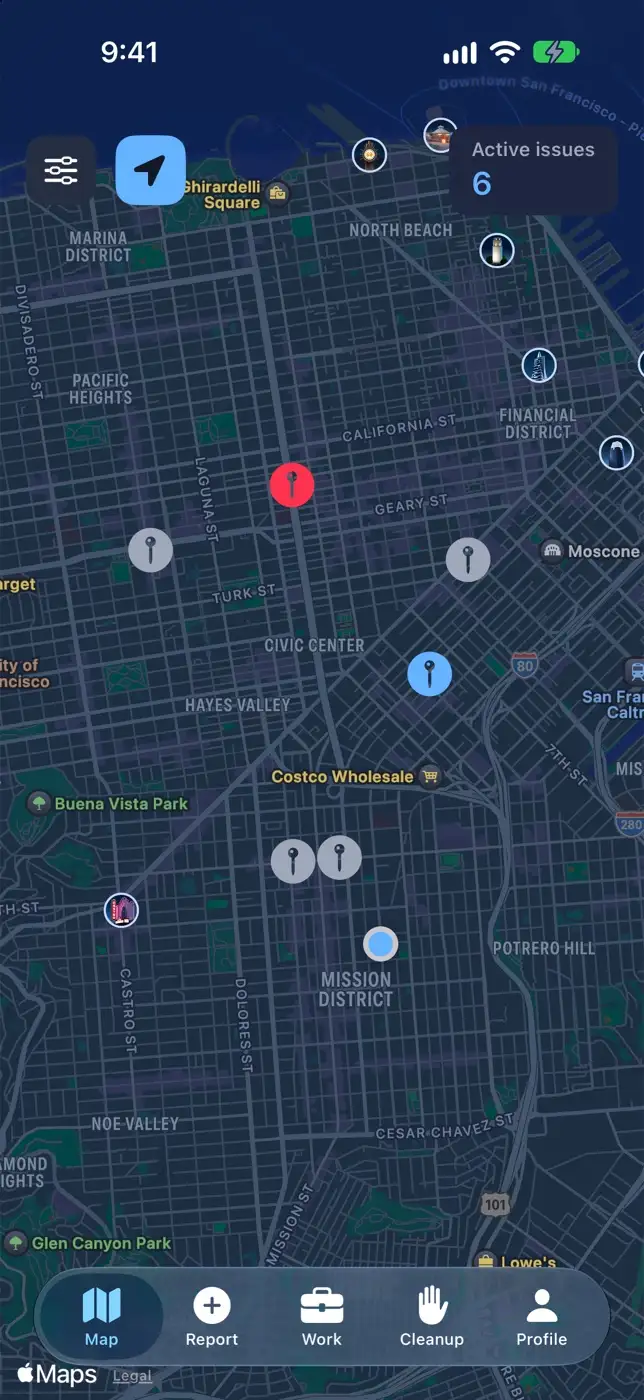
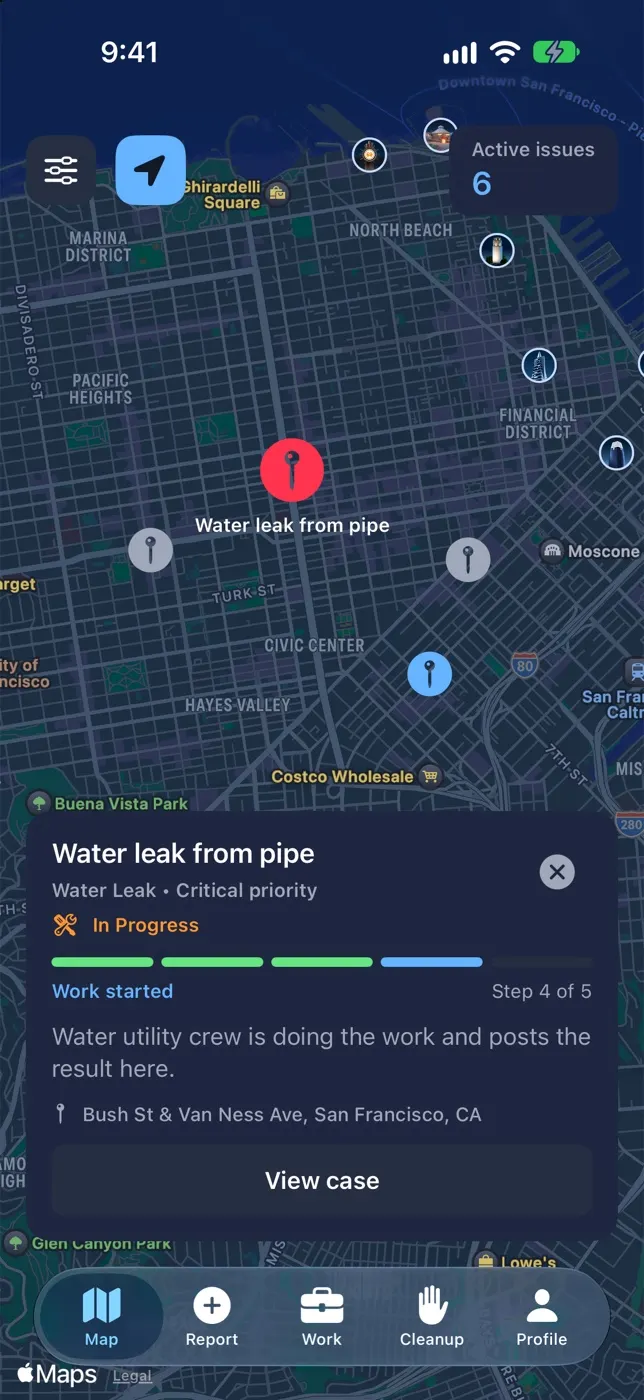
See what is already reported
The app opens on a map of open issues. Tapping a pin shows the issue, its stage and who has it, so a resident can check before reporting a duplicate.
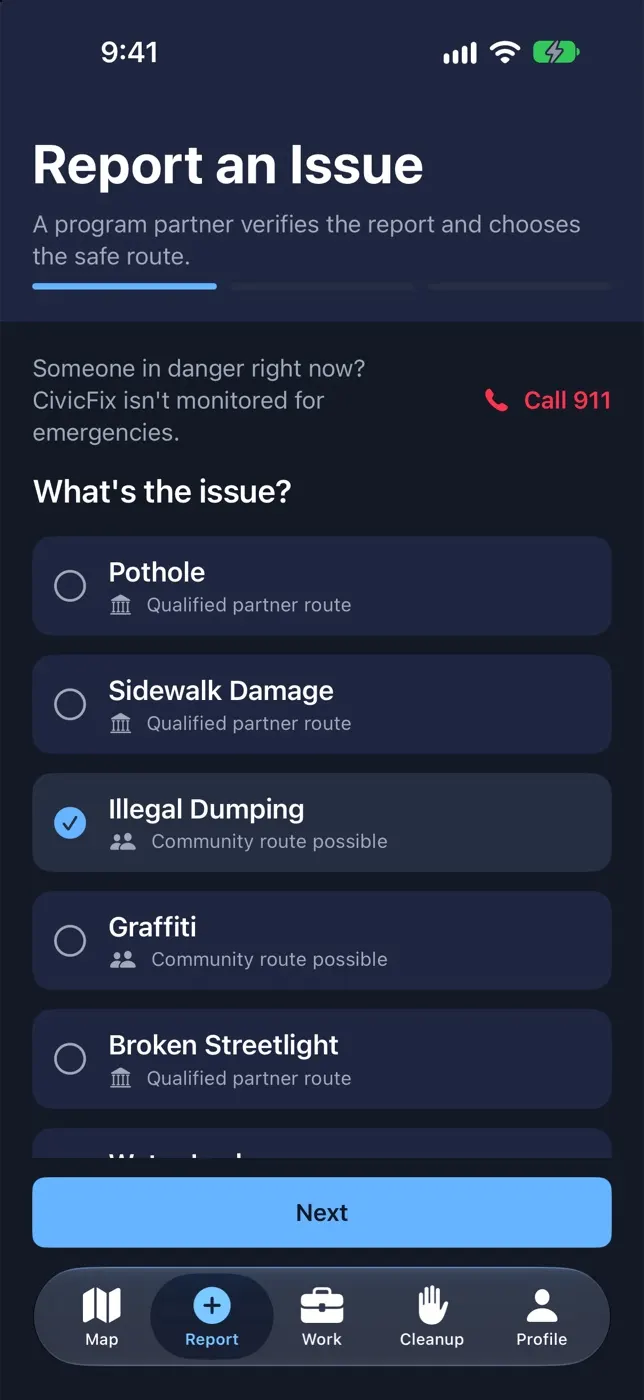
Report in three short steps
Choose a category, describe what you can see, attach a photo and location. Each category says up front whether it can become community work. A Call 911 link sits above the form for emergencies.
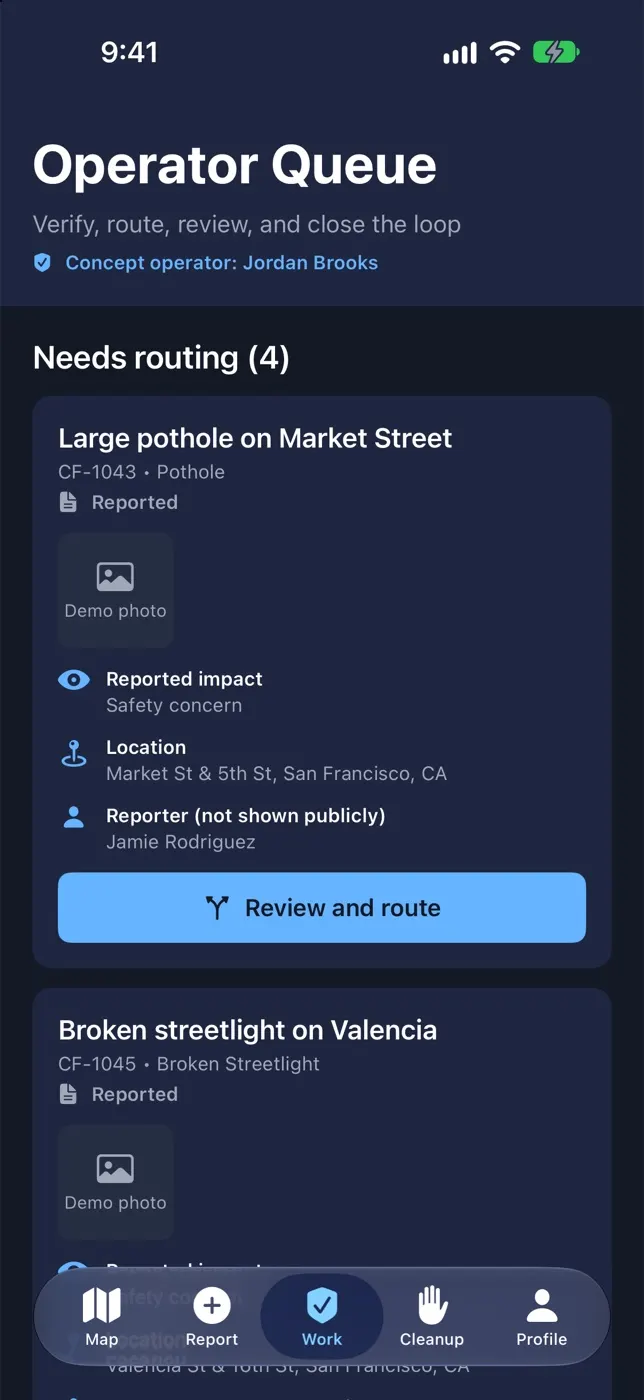
Every report lands in one queue
A program operator sees each new report with its evidence, location and reported impact. The reporter's name is visible to the operator but never shown publicly.
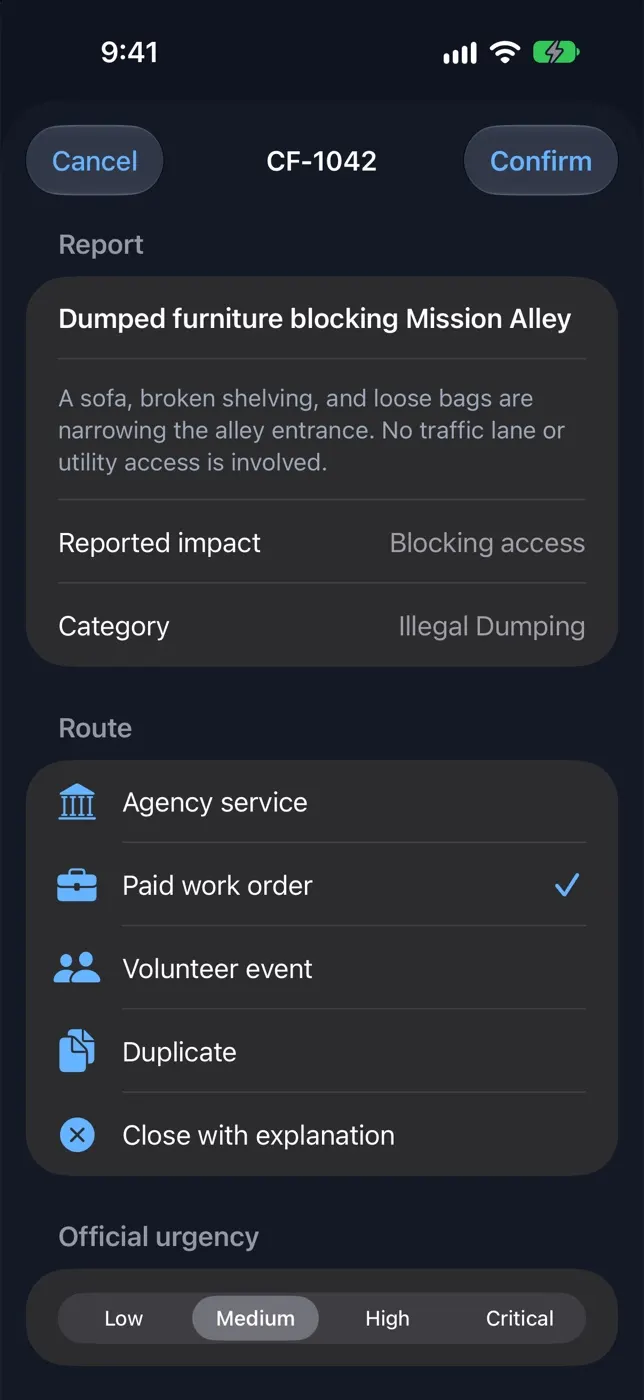
Choose a route the reporter can read
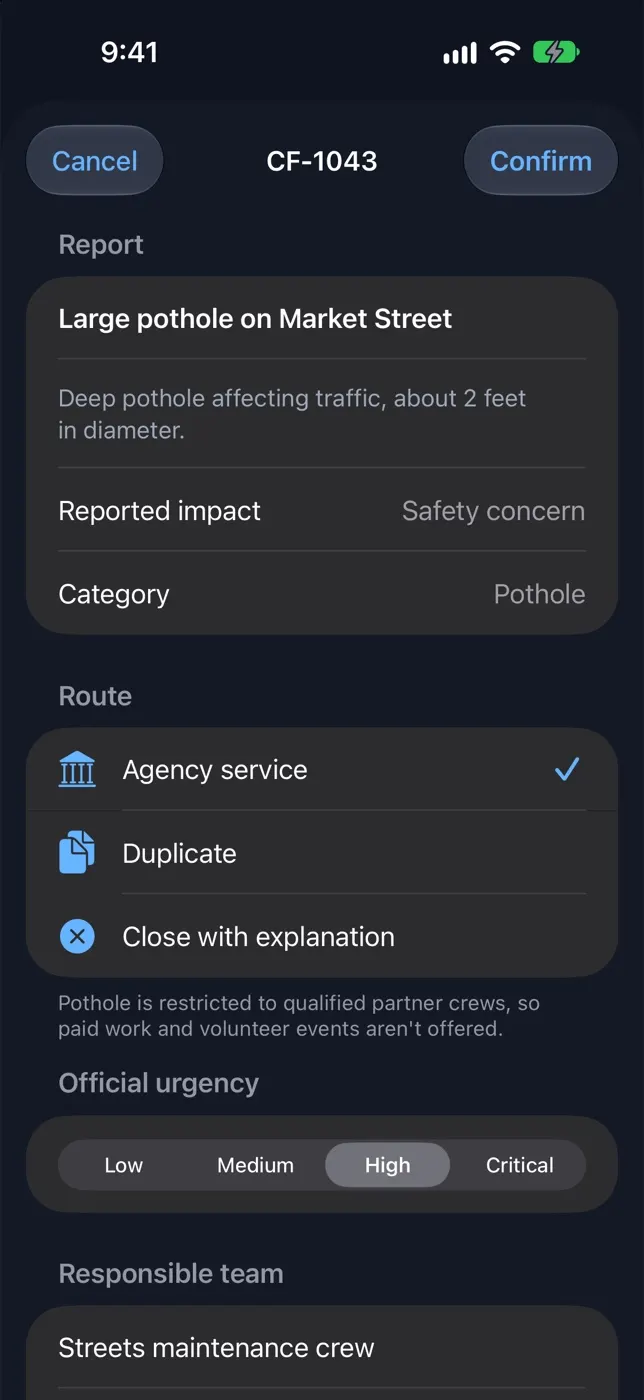
The operator picks one of five routes and sets the official urgency. For low-risk work like dumped furniture, that can be a paid work order funded by an accountable partner.
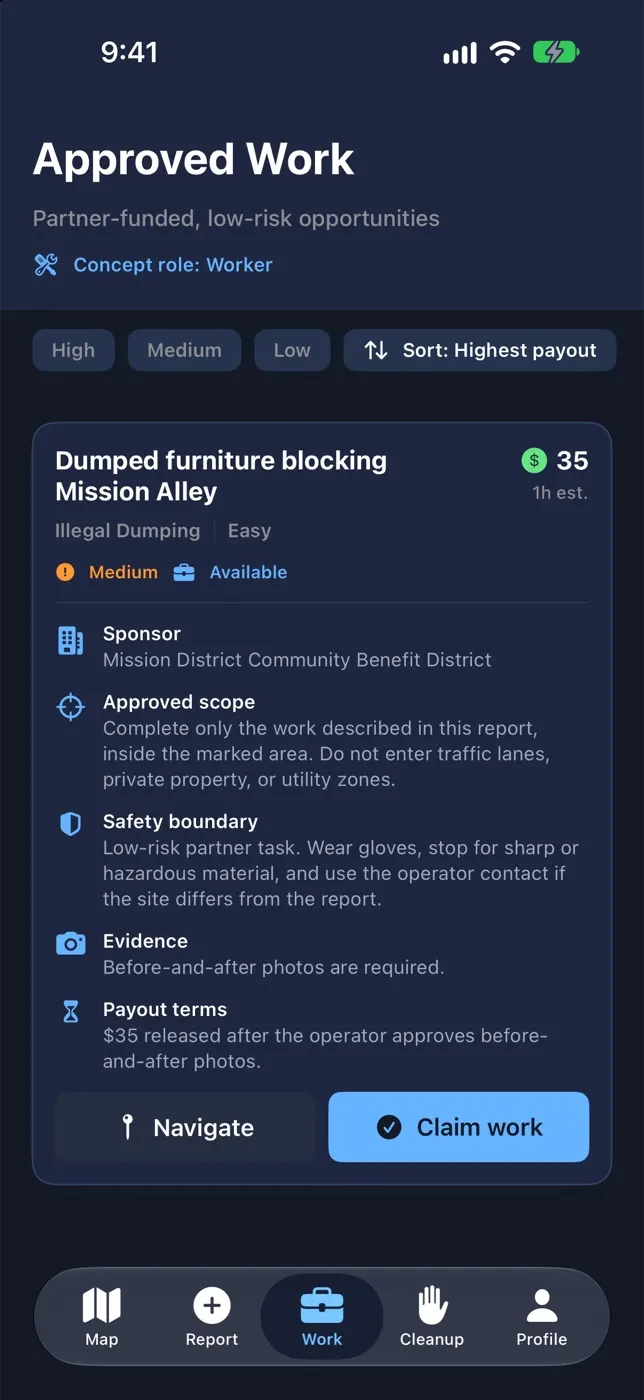
Claim only what you have read
An eligible worker sees the sponsor, approved scope, safety boundary, evidence checklist and fixed payout before claiming. Claim, start and submit are separate, deliberate steps.

Proof before payout
The worker submits real before-and-after photos. Payment is held until the operator approves, or the operator sends back a change request with a reason.
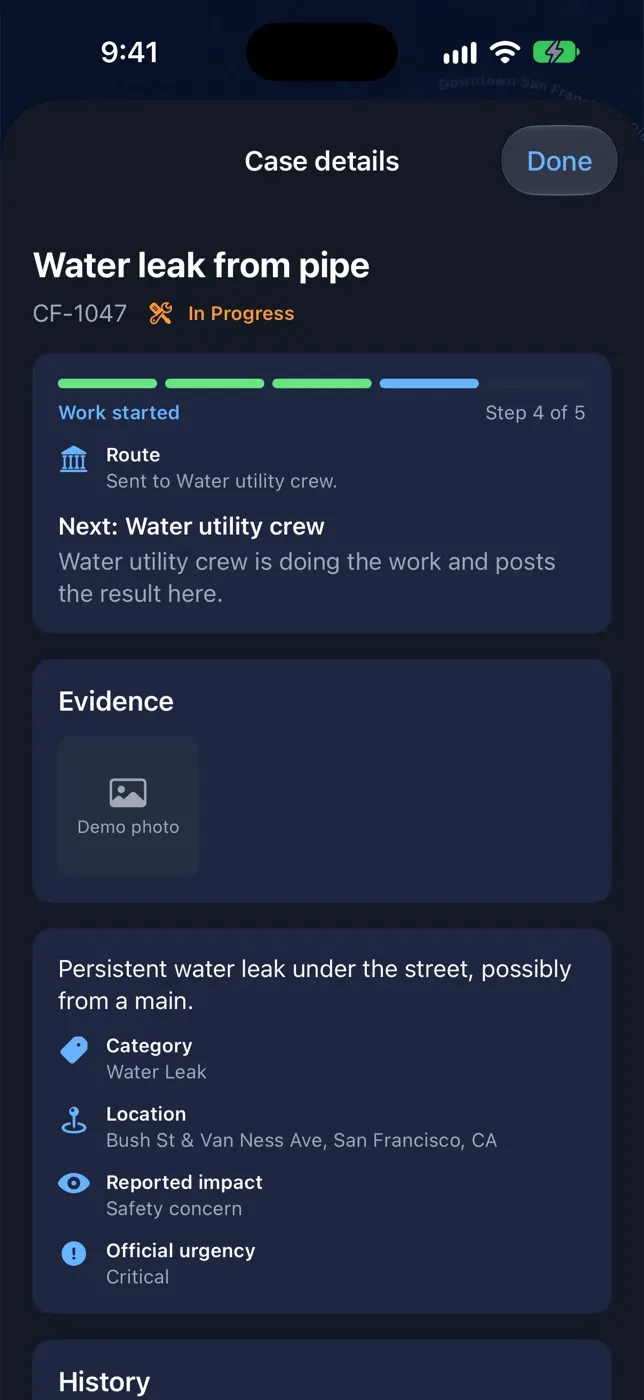
The loop closes with the reporter
Every report has a case page with its route, the next owner, evidence and full history. The person who reported it can see who has it and how it ended.
- 01
Reported
A resident submits evidence and observable impact. The report is not yet verified and carries no promise of paid work.
- 02
Verified and routed
The operator removes duplicates, confirms jurisdiction, assigns official urgency and chooses a route.
- 03
Available
If the route is paid work, a partner-funded, low-risk work order becomes visible to workers who meet its requirements.
- 04
Claimed and in progress
One qualified worker accepts the scope, checks in and follows the safety and evidence checklist.
- 05
Under review
Before-and-after proof is submitted. Payout is held while the operator reviews it.
- 06
Approved and closed
The operator approves or requests changes, releases payment and publishes the outcome back to the original report.
06Routing and the safety boundary
Each verified report ends in exactly one of five routes, and each route comes with a reason the reporter can read. Try the operator's route sheet: pick a category, then a route.
Community route possible. Pre-approved removal can be a paid work order.
A partner-funded work order was posted. You will see before-and-after photos when it is done.
Two rules hold regardless of route. First, road, utility, electrical, water, wildfire, traffic-adjacent and other regulated work is routed only to qualified partner crews and can never be published as community paid work. Second, the community-work starting point is deliberately narrow: litter pickup, pre-approved removal of dumped items and supervised cleanup events. Residents describe the impact they see; the operator, not the reporter, assigns official urgency. Anyone in immediate danger is sent to 911, because CivicFix is not an emergency service.
07Three separate ledgers
Community contribution, paid work and volunteering are related but never interchangeable.
- ✦
Civic Points
Recognition for reports, granted only after an operator verifies the report.
- $
Cash
Earned only for partner-approved work, released only after the operator approves the proof.
- ◷
Volunteer hours
Recorded for cleanup events and never shown as paid earnings.
Keeping these apart avoids turning reporting into a bounty system and keeps paid work inside a funded, reviewed program.
08Trust, privacy and evidence
- Reporter names are visible to the operator for follow-up but never shown on public map cards.
- Location and time attached to a report support review but do not by themselves prove it is true; duplicate and fraud review stay with the operator.
- If location permission is denied, the reporter places the pin by hand instead of receiving a made-up default location.
- Workers see the sponsor, scope, safety notes, evidence checklist and payout terms before they claim. Payment is held until review, and a change request reaches the worker with its reason.
- Public status language distinguishes reported, verified, in progress, under review and completed, and is never shown by color alone.
09What the prototype shows
The concept is built as a working SwiftUI iPhone app using MapKit and Core Location. It runs the full loop on one device with three switchable roles. Any new report, not only a seeded demo case, can be submitted with real photos, routed by the operator, claimed and documented by a worker with before-and-after photos, reviewed, and closed back to the reporter. Restricted categories remove the paid and volunteer routes automatically. State persists between launches, and a demo reset clears saved data and photos.
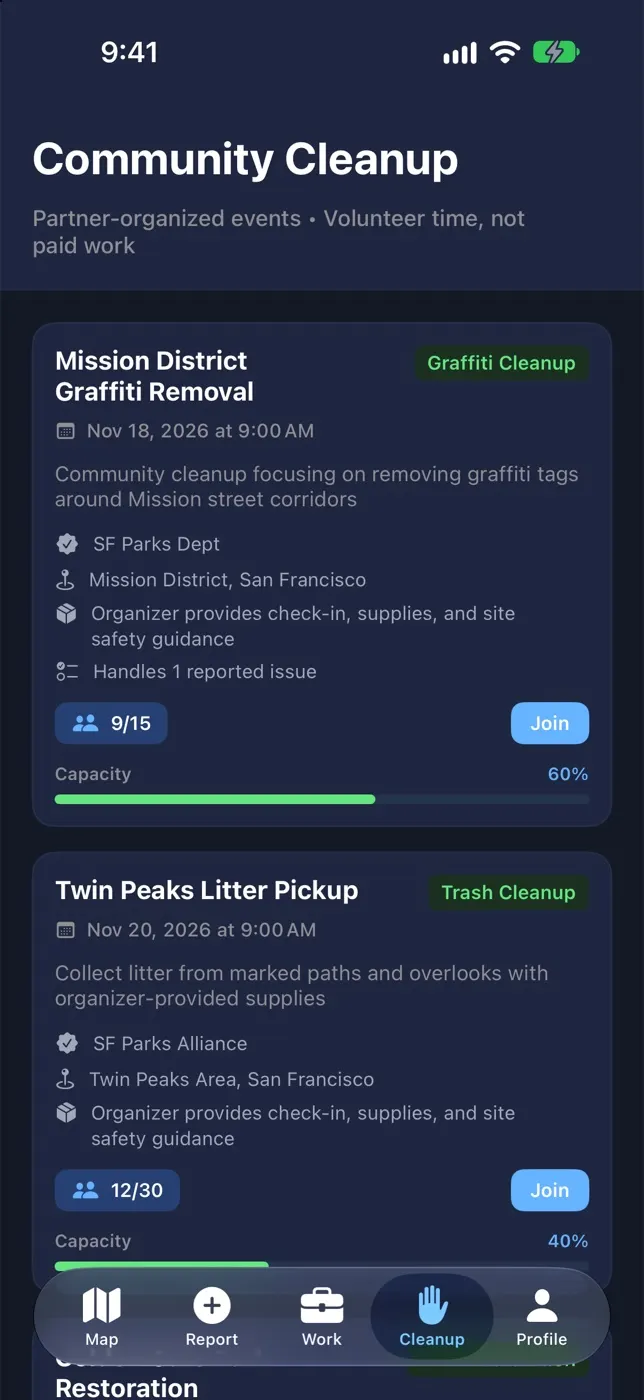
Volunteer cleanups
Partner-organized events with organizer, date, capacity and what is provided. Volunteer time is never counted as paid work.
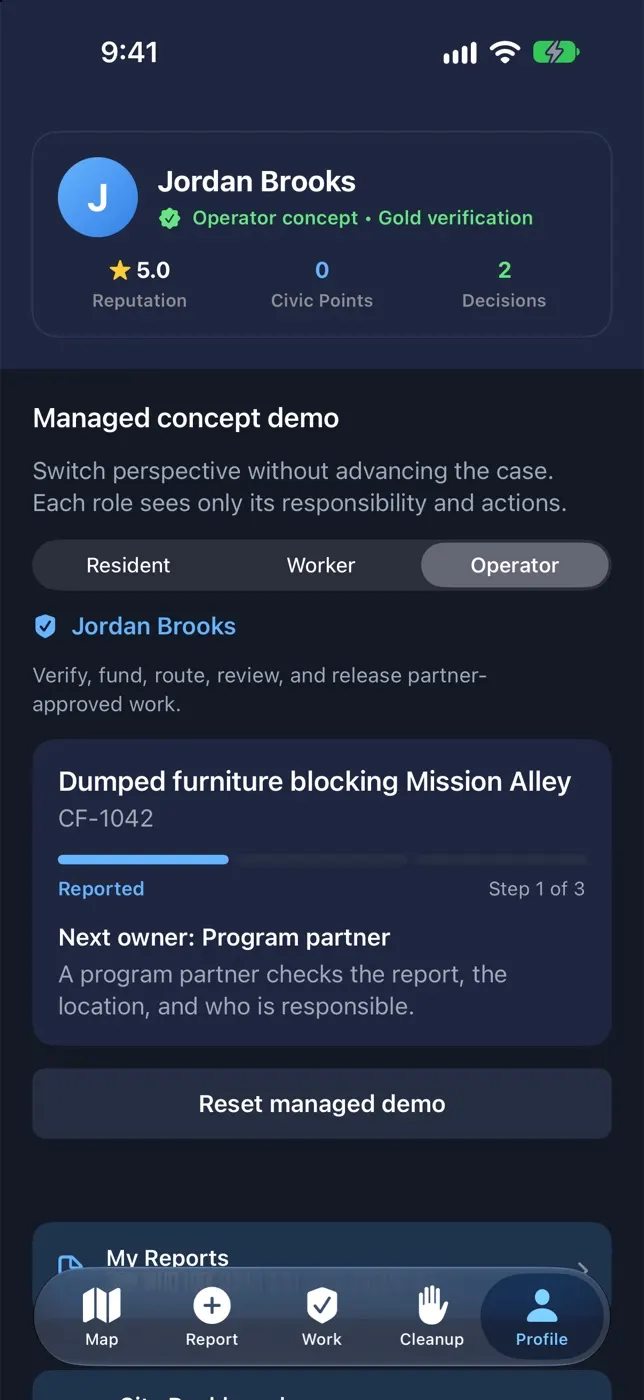
Three roles, one device
A role switch lets anyone walk the whole loop as Resident, Worker and Operator, each limited to its own actions.
It is a concept, and the limits are stated in the app itself. It does not authenticate real people, verify identity, authorize public work, store evidence on a server or move money. Dashboard figures are illustrative. No city partnership, user research or legal review exists yet.
10Proposed pilot
Proposal · none of this has been run
A first pilot should be small enough to observe closely: one operating partner, one district and one low-risk category. Illegal dumping is a good candidate because it is common, visible, easy to photograph before and after, and does not require a licensed trade. The partner would fund a fixed number of pickup work orders at a set payout, approve a short list of verified workers, and agree on review and payout times it can actually meet.
Measures worth tracking from the first week:
- Time from report to a routing decision.
- Share of reports whose reporter can see a route and a final outcome.
- Time from proof submitted to approval, and how often changes are requested.
- Duplicate rate, and how many reports are closed with an explanation.
- Whether residents who see an outcome report again.
11Path to production
The architecture guide in the repository outlines the services a real deployment needs, added behind the same models the prototype already uses:
- Authentication and role authorization, with worker and operator access granted by the partner.
- A REST API and PostgreSQL database for issues, jobs, users and case history.
- Evidence photos uploaded to object storage through signed URLs.
- Push notifications so reporters and workers hear about route, review and outcome changes.
- A payment provider for partner-funded payouts, with identity verification and tax handling.
- Moderation, accessibility verification, security review and field testing before any public launch.
12Open questions
These are decisions for a first partner, not things the software can settle.
- 01Which city, agency or civic organization is the first operating partner?
- 02Who funds paid work, who approves it, and what legal and insurance requirements apply?
- 03What exact low-risk task list, equipment checklist, insurance coverage and escalation path will the first partner approve?
- 04What is the minimum evidence required before a report can become a job?
- 05Which verified resident actions earn Civic Points, and should points stay recognition-only during a pilot?
- 06Can one account hold more than one role, or should worker and operator access stay separate identities?
- 07What review-time and payout-time service levels can the partner honestly promise?